
Skip to content

Services

Civils for utility networks

We carry out the civils for electricity, telecoms, public lighting and water networks: trenching, duct formations, joint bays, chambers, sub-duct, column bases and reinstatement. Our own crews carry the work, and every location is recorded.

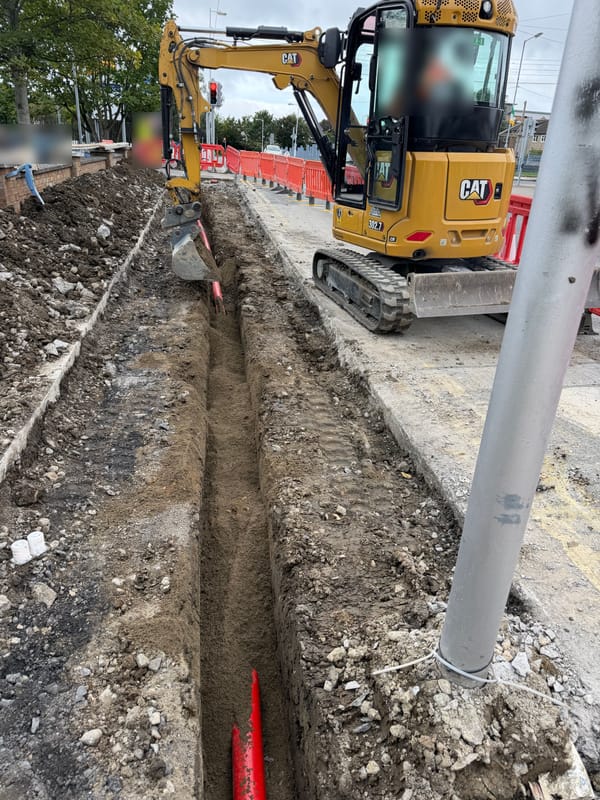
A CAT mini excavator digging a duct trench along a footway, with pedestrian barriers along the road edge.
Trenching behind pedestrian barriers
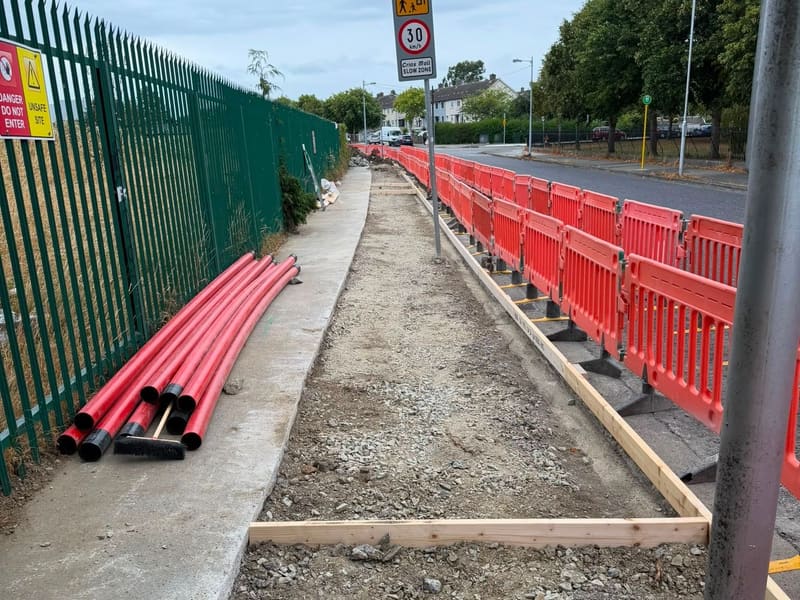
Red duct lengths stacked beside a footway prepared with formwork, behind barriers.
Duct stock and prepared footway
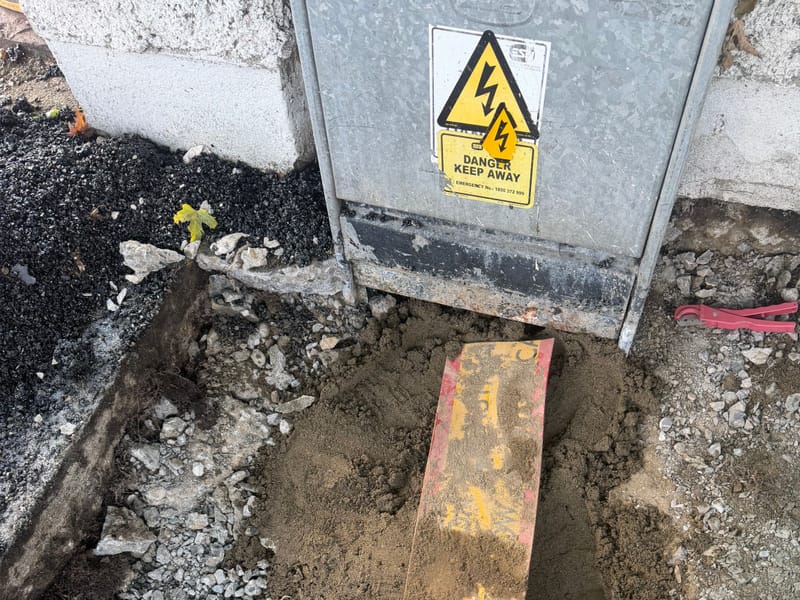
An excavation beside a feeder pillar with a "Caution electric" cable cover board exposed in the ground.
Cable protection exposed beside a pillar
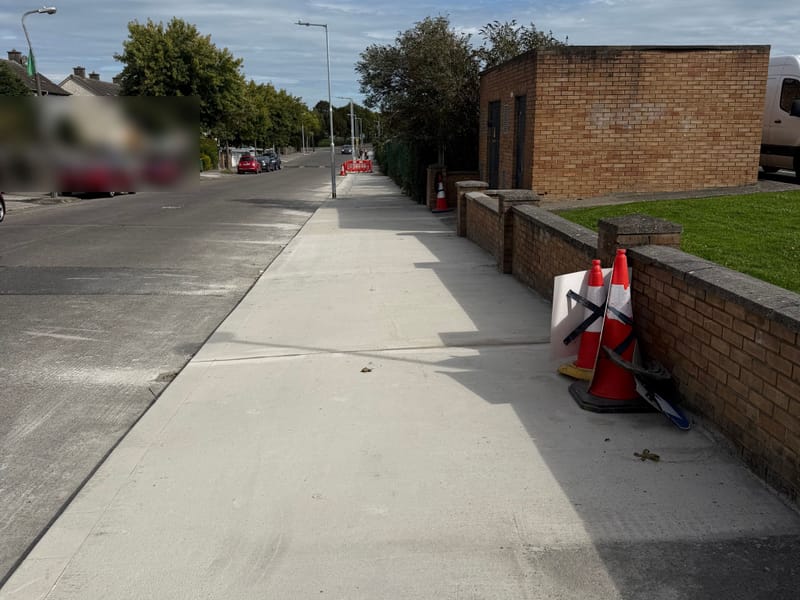
A long run of new concrete footway beside a road on a sunny day.
Finished concrete footway

Our services

Power cable trenching and ducting

Open-cut trenching, duct formations, joint bays, chambers, cable protection and reinstatement for LV and MV cable routes.

  • Trial holes and slit trenches to locate existing services and prove the route
  • Open-cut trenching in carriageway, footway, verge and field, with earthwork support where the depth needs it
  • Single and multi-way duct formations, bedded, surrounded and backfilled to specification
  • Joint bays and cable chambers, precast or cast in place
  • Feeder pillar and mini-pillar bases and duct entries
Power cable trenching and ducting in detail

Fibre and telecoms civils

Sub-duct installation in existing ducts, blockage clearance, new duct and chambers, fibre cable installation and reinstatement for fibre networks and data-centre connections.

  • Rodding and roping existing ducts, and installing distribution and feeder sub-ducts through them
  • Clearing silt and debris from chambers so ducts can be rodded
  • Locating and clearing duct blockages, opening up the ground where a blocked section must be bypassed
  • Trial holes to locate and record existing services
  • New HDPE duct by open trench in grass, footway and carriageway, including road crossings

Fibre and telecoms civils in detail

Public lighting civils

Breakout, column bases, column removal and installation, ducting, junction-box chambers and reinstatement for lighting upgrades.

  • Route walk and mark-out with the road authority and the main contractor
  • Breakout of concrete, tarmac and paving at existing and new column positions
  • Excavation for new columns and breakout of old column bases
  • Removal of old columns and installation of new columns, with lorry-mounted crane lifts
  • Trenching and ducting between columns and feeder pillars, including road crossings

Public lighting civils in detail

Concrete and reinstatement

Breakout and reinstatement of footpaths, kerbs, paving and driveways after utility works, measured and photographed.

  • Saw-cutting and breakout of concrete, tarmac and paving
  • Concrete footpath and bay reinstatement
  • Kerbs and tactile paving
  • Block and modular paving
  • Tarmac driveways and temporary tar surfacing

Concrete and reinstatement in detail

Scope and interfaces

Where our work starts and stops

Clear boundaries make subcontract works easier to price, programme and supervise. This is how our scope usually divides from the trades around it.

We carry out

  • Trial holes, slit trenches and service location
  • Breakout, excavation and open-cut trenching
  • Duct formations for power and telecoms, and sub-duct installation
  • Joint bays, chambers, pillar bases and column bases
  • Column removal and installation on lighting programmes
  • Duct proving and cable protection
  • Backfill, compaction testing and reinstatement
  • Photographs and measurements for every location

Carried out by others

  • Electrical work: cable jointing, termination, testing, energisation, ESB Networks transfers, lanterns and brackets
  • Cable installation at 38kV and above
  • Fibre splicing, testing and network design
  • Route design and network approvals, which come from the client and the network operator

We sequence our work around those trades and their visits. Directional drilling and moling are carried out by specialist partners that we manage within our programme.

Traffic management

Planned with each job, not added afterwards

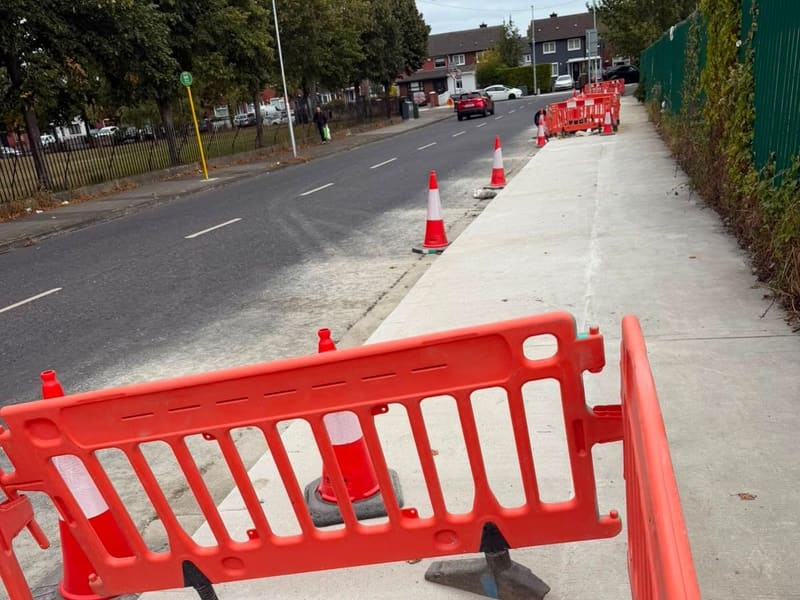
Finished concrete footway beside a main road, with barriers and cones still in place.
Finished footway, traffic management in place

Every opening has a temporary traffic management plan to Chapter 8 of the Traffic Signs Manual, including the route for pedestrians past the works. Our crews set out and maintain the signing, lighting and guarding under a named traffic-management competent person.

Road crossings and lane closures follow the hours and conditions in the road-opening licence. Where the works need a dedicated traffic-management crew, we arrange it through a specialist contractor and run it as part of our programme.

What we record

What a trench record shows

Most of our work ends up underground. These are the points at which we photograph or measure it, so the record shows what the finished surface hides.
Illustrative footway duct trenchA cross-section through a footway showing the cut edges, the reinstated surface, sub-base, compacted backfill and two ducts in their surround, with the excavation depth marked. Numbers match the list beside the drawing.WIDTH MEASURED123456

Illustrative section

  1. Saw-cut and breakout, to the extent agreed on site
  2. Reinstated surface, measured by surface type
  3. Sub-base
  4. Backfill, compacted and checked with a Clegg impact tester
  5. Duct in its bedding and surround
  6. Excavation depth, photographed with a measure

Not to scale. Widths, depths and materials follow the specification for each job.

Contact

Discuss your project

Tell us where the work is, what it involves and when it starts. We will come back to you to talk it through.